


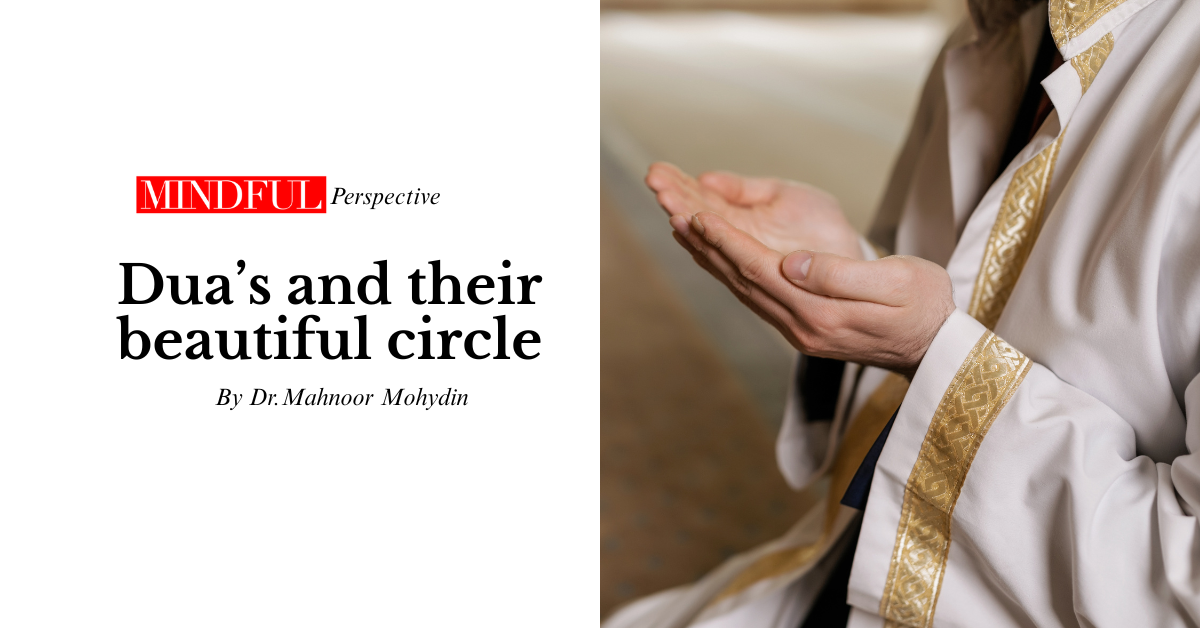
Supplications have a powerful way of helping establish a profound connection and mindfulness. The beauty in reciting the following Dua is in asking Allah SWT for a united family unit. To have a spouse and children that would “bring comfort” and be a positive influence on the community by being “examples for the righteous.” These are core values and ethics with which we could build our behaviors and personalities around.
Rabbana hablana min azwaajina wa dhuriyyatina qurrata A’yunin waj’alna lil- muttaqina imama
“Our Lord! Grant unto us spouses and offspring(s) who will be the comfort of our eyes, and give us (the grace) to lead the righteous.”
(Surah Furqan, Ayat 74)
Purpose:
– Most known for praying for a righteous life partner and a pleasurable marriage.
– If already married, to pray for the sustainability of the marriage and that Allah SWT keeps joining your hearts with Mercy and Love
– Asking Allah SWT for obedient children that are positive influence on others.
– Can also be recited for married couples looking to conceive righteous children.
– Can be recited when you are expecting and want to ask Allah SWT for a safe pregnancy and a healthy new born.
Explanation:
– Rabbana means ‘Our Rabb’. It is a collective Dua. For the whole Ummah. Dua in the plural sense. Not just for yourself but for all your dear ones . Rabbi is used in a singular context, denoting ‘My Rabb’.
– The word Hablana comes from the Name of Allah, Al- Wahab: Giver of gifts!
– So it’s meaningful emphasis is: “ O’ Rabb, give me a Gift”
– Azwaj means spouse. It is used for both wife and husband. It is gender neutral. There is a subtle emphasis on how a spouse/partner is a ‘Gift from Allah’.
– Zurriyat is one’s offspring = children, grandchildren & all your descendants. Not just biological, but also your spiritual Zurriyat. It can be students for a teacher. They are also a Gift of Allah to you.
– Qurrata Ayan is ‘coolness of eyes’. It is an expression to describe being a source of comfort, happiness & peace — such that when you look at them, you feel safety. You feel at home. ‘Dekh ka Dil Khush ho jahta hai!’ You like and enjoy their company. You have a deep understanding. You have companionship. You love them, and they bring you great pleasure!
– Imam means leader! The one in authority over the one who shows the way. Like how we say ‘masjid ka imam‘. Similarly, ‘Ghar ka Imam’- the leader of the home. Asking Allah SWT to make us worthy so that we take care of the righteous and be an example to them in a leading capacity.
The term coolness of eyes was a form of great expression for the Arabs. As there was dust and dryness in the desert sand. They worked and traveled in it. When the dust got in their eyes, it was a source of significant discomfort. On the contrary, something that brings coolness to the eyes is what brings comfort. Hence, this purposeful expression!
Interestingly, the value of this expression can be assessed from how the Prophet (SAW) used to say “Salat is coolness to my eyes”. So a blissful family with a good spouse and righteous children is this special — they are coolness to one’s eyes! The same expression is used to describe them, which is also used for Salat (our namaz).
This leads us to see the link with how the Dua of Hazrat Ibrahim AS highlights asking Allah SWT to make his ‘zurriyat (descendants)’ the establishers of Prayer! So they can seek and achieve the coolness of eyes, alongside seeking forgiveness for themselves, their parents, and all the mumineen (believers).
Rabbij‘alni muqimas-salati wa min dhurriyyati, Rabbana wa taqabbal du‘a’. Rabbana ighfir li wa liwalidayya wa lil-mu’minina yawma yaqumu al-hisab.
“My Lord, make me an establisher of prayer, and [many] from my descendants. Our Lord, and accept my supplication. Our Lord, forgive me and my parents and the believers on the Day the account is established.”
(Surah Ibrahim, Ayat 40 & 41)
(Writing inspired from the lectures of teachers: Hājrah Khan & Umme Nukhbah)

