


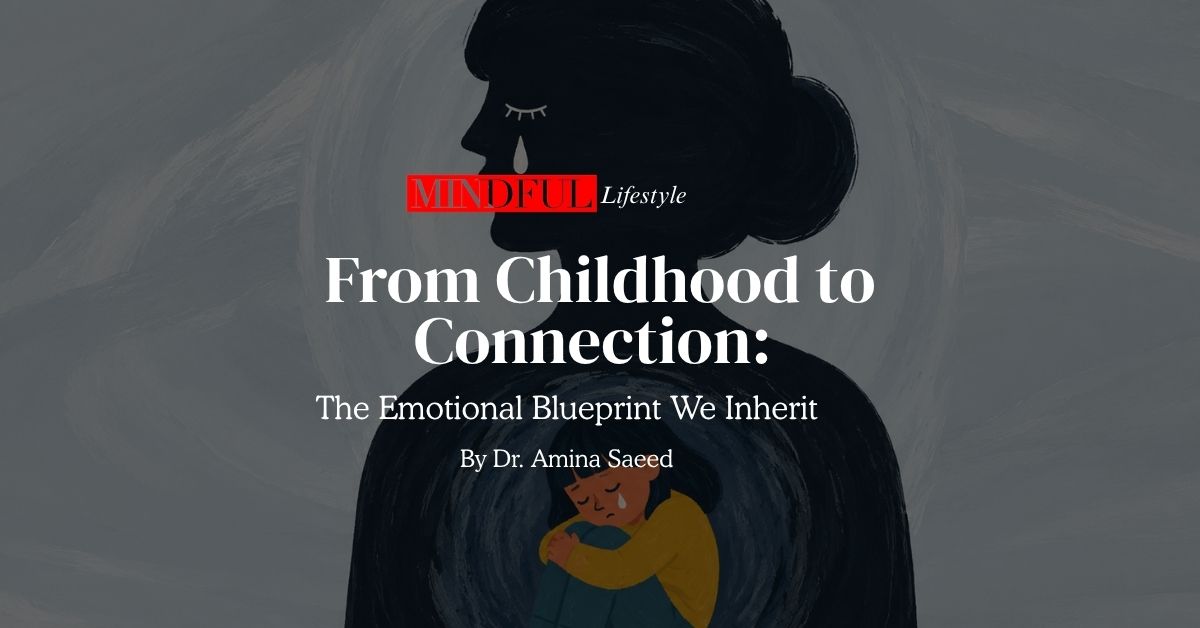
Dr. Amina Saeed reflects on how unspoken childhood experiences quietly shape the way we love, communicate, and connect in adulthood—and how awareness of these patterns can open the path to healing.
This month, in one of my book clubs, I read Strangers, a #1 New York Times bestselling memoir by Belle Burden about marriage and divorce. It was a palpable narrative—raw and heartbreaking—but towards the end, she finds a sense of peace, stating that her spouse was not a villain; he was a man shaped by his own wounds. That reflection not only brought her aching soul some rest but also spoke volumes about how our childhood experiences shape our adult relationships.
Some elements of our personality are encoded in DNA, but life experiences—parenting, relationships, culture, stress, loss, and conscious habits— shape how those tendencies actually show up. Even within the same household, each child develops a different personality despite sharing the same parents. The difference lies in the fact that humans are constantly evolving. In truth, you do not meet the same person twice.
The way we are spoken to, corrected, loved, ignored, and protected during childhood becomes the invisible blueprint for how we connect with others in adult life.
Sometimes we attribute everything to qismat, naseeb, and destiny, but often forget that our earliest emotional experiences leave lasting footprints on the heart. The melancholy of it runs through the veins. It resides in the bones—quiet for years—until suddenly it surfaces in the most unexpected ways and places.
The key is not to ignore it, but to identify it, acknowledge it, and address it.
Emotional safety is something a child is instinctively drawn to, without needing to be taught. A child feels safe when they are loved, heard, and not governed by fear. Yet emotional wounds carried in childhood can echo silently into adulthood.
Emotional trauma does not always need to be large to have an impact. Sometimes even subtle responses can trigger silence or withdrawal, where emotional expression is not allowed. Words like, “rona band karo,” “sher bano,” “ab kya ho gaya,” “zyada sensitive na bano,” “log kya kahenge,” “chup karo, bas bhi karo,” or “peeche hatt jao,” are often enough to disrupt the natural human ability to process emotions in a healthy way. In adulthood, this can manifest as emotional silence, affecting relationships and compatibility.
So what can we do to begin changing the narrative?
- Acknowledge someone’s feelings: “I understand you are upset” instead of shutting them down.
- Understand that emotional intelligence (EQ) is different from IQ—and equally, if not more, important.
- Apologize after losing your temper.
- Avoid the blame game. Our parents loved us with the tools they had; we must take responsibility for breaking or reshaping the pattern.
- Teach emotional expression, not emotional suppression.
- It is not only what you say, but how you say it.
- Avoid being overly critical.
- Practice compassion.
- Listen to understand, not to correct.
- Be present.
- Learn to agree to disagree.
True wellness does not come from matcha, PRP facials, or gym routines alone. It is layered—beginning at a deeper, more cellular and emotional level, rooted in the soul. The quality of our relationships profoundly shapes our mental and physical health, and vice versa. You cannot isolate a single thread without affecting the whole fabric.
Sometimes, healing the present requires understanding and accepting the past. And the greatest gift we can give ourselves and one another is not self-criticism, but self-acceptance in its most authentic form—not perfect, but original.
May we rewrite our stories into ones that are rich with love, kindness, and compassion—for ourselves and for those around us—so we may build more fulfilling relationships in the present and future.

