


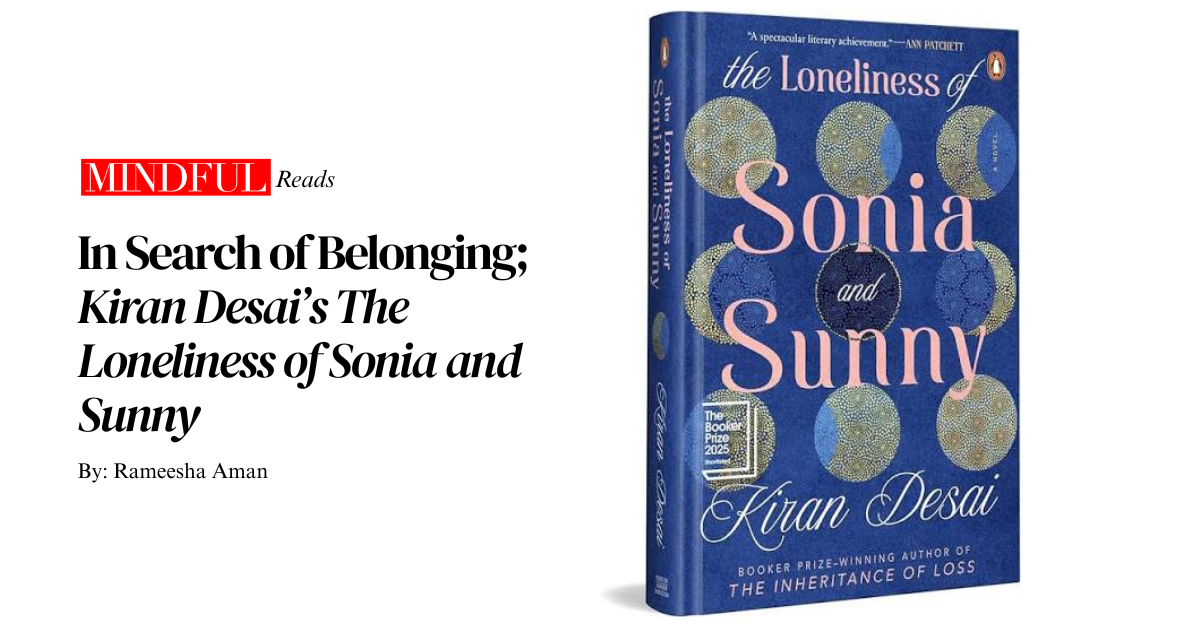
Rameesha Aman delves into Kiran Desai’s sweeping tale of love, loneliness and displacement, examining how class, culture and the search for belonging shape the lives of two people caught between worlds.
Kiran Desai’s third novel, The Loneliness of Sonia and Sunny, comes nearly twenty years after her second book, The Inheritance of Loss, which won the Booker Prize in 2006. The scope and scale of the novel perhaps justify this gap, as it is expansive in its geographical range, intricacy of plot and variety of characters.
The Loneliness of Sonia and Sunny is set at the turn of the millennium and explores themes similar to those in The Inheritance of Loss, and might even be considered an extension of them. These include cultural differences, immigration and its struggles, social class and postcolonial violence. The plot moves elegantly between distinctive voices, combining observed realism with an undercurrent of magical realism.
As evident from the title, loneliness is the central dilemma of the book. The main protagonist, Sonia Shah, struggles with it while studying in the United States. Her vulnerability makes her an easy target for an older man, who subsequently takes possession of her life and exploits her weaknesses. Eventually tired of this relationship, Sonia returns to India, where she encounters Sunny Bhatia, a journalist based in New York.
Sonia and Sunny have been targeted by their respective grandparents in a botched attempt at matchmaking, creating a barrier between them from the outset. From this point, the story revolves around their relationship, which is beset by every type of obstacle. Sonia is unable to let go of the memories of her previous relationships, while Sunny’s mother is aggressively opposed to Sonia’s presence in her son’s life and does everything she can to separate them. Throughout these vicissitudes, the characters struggle with an overwhelming sense of solitude.
The narrative is free of flashy literary flourishes, and among the pleasures of Desai’s writing is her sharp focus on what the characters are eating, what they are wearing, and how their living quarters are arranged and decorated. There are ample descriptions of kebabs in the making, while the saris are described with elegance and affection. Broader tensions and circumstances also drive the momentum of the book. The fall of the Twin Towers changes New York and has a significant impact on Indian immigrants, as well as on India itself. These tides of change therefore shape the lives of Sonia and Sunny, and the changes are not always driven by compassion.
While the main characters are well thought out and nuanced, the serial-like mannerisms of the supporting cast can become cumbersome to read. The narrative relies, in large part, on mannerisms such as Sonia’s father’s helplessness and her mother’s insistence on adopting white, provincial manners. It can be argued that these mannerisms help create obstacles for Sonia and Sunny to be together, but after a while, it becomes evident that they could have been scaled back.
It can also be said that The Loneliness of Sonia and Sunny is a slow-paced, traditionally written book and therefore needs to be generous with its details in order to register as a work of significant impact. Thus, the question of the book inevitably comes down to its length. Shortening it might have improved its narrative focus, but that would also have meant eliminating one of its strongest aspects: its incisive and complex commentary on Indian culture, class and the diaspora.

