


By Advocate Maha Shafqat
As a divorce lawyer, I’ve seen the grandest weddings lead to the most disastrous marriages. What many fail to realize is that a wedding is merely the prologue to the book called marriage — each chapter filled with its own highs and lows. There’s no magic formula to ensure that a marriage will last, even when everything looks perfect on paper. A happy ending can never be promised, but what can be secured is a smooth exit if things fall apart. Marriage is a gamble anywhere in the world — which is exactly why tools like prenuptial agreements exist in the West.
In a country like Pakistan, where marriage isn’t merely a union between two individuals but an alliance of entire extended families, many relationships falter under the weight of persistent interference from in-laws, unequal power dynamics—often at the expense of the bride—and a host of other factors. These can range from basic incompatibility to more complex issues such as closeted sexual orientation, abuse, or infidelity. Since there’s no assured formula for success, the best you can do is understand your rights and fill out the marriage contract with utmost care — every word carries weight and can bring either ease or difficulty if the marriage doesn’t work out.
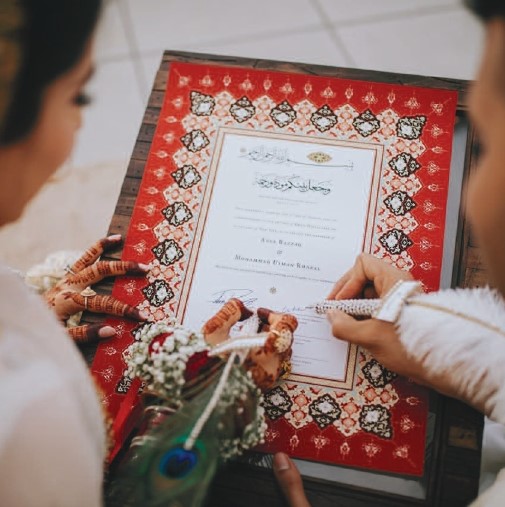
Before I talk about marriage laws, there’s one piece of advice I want to give to anyone planning to get married: don’t do it just because everyone around you is. Marriage can change the entire course of your life, so make sure you’re doing it for the right reasons. It’s important to have open, honest conversations with your partner before signing the marriage contract. Think of it like any other legal agreement — you wouldn’t sign a lease without reading the fine print or consulting a lawyer. This is, after all, the most significant contract of your life. Discuss every term and condition thoroughly and ensure your protection in case things don’t work out. When the nikahnama is examined in court, vague wording often becomes the loophole lawyers exploit, so make sure each clause is clear, specific, and based on mutual consent.
Yes, marriage is a sacred union, but it’s also a civil contract. Islam doesn’t uphold the idea of spending seven lifetimes with the same partner or the notion of “till death do us part.” Talaq and khula are God-given rights because even God acknowledges that marriage is a delicate bond — one that can break.
Understanding the nikkahnama:
The contract itself is a simple, standard document that can be divided in 3 parts. The first and least confusing part of this contract ranges from columns 1-12, these columns include basic details such as name, CNIC, age, lawyers & witnesses’ information, and date of execution etc.
The second part starting from column 13 and going all the way till column16, is the most important part of this contract in terms of financial security of the bride, also known as the Haq Meher. This is a compulsory monetary obligation on the groom and a god given right of the bride to safeguard her financial well-being. The content of which can be of anything of value such as cash, gold, shares or even immovable assets such as land or house. It is of two types, muajjal which is paid as soon as the contract is signed, and ghair muajjal or deferred dower, that can be paid at a later date, or in the event of divorce. Column 13 refers to the amount of dower, 14 to the amount of muajjal & ghair muajjal dower, 15 if any amount has been paid in muajjal, and 16 if any property is given as meher, detail of the said property & price/value of it. If property is your choice of meher, please do the paperwork either beforehand or right after to avoid any conflicts later.
The third part of the nikahnama starting from column 17, includes any special conditions (as long as they are compatible with shariah), and can include anything from monthly maintenance to separate accommodation to permission or prohibition to work. It’s important to note that this column along with the previous haq meher columns serve the purpose of a pre-nup and can be used as such to protect both parties as long as the terms don’t contradict Shariah, are mutually understood & agreed upon and are specific & clearly worded.
The trickiest and the most controversial part of the nikahnama is the bride’s delegated right to divorce (Talaq-e-Tafweez) & restrictions on the groom’s right to divorce. Through column 18, the groom can delegate the right to divorce to the bride. It’s important to understand this column and fill it out correctly as in the past, erroneous entries have caused the column to become redundant. This specific right can be delegated to the bride with or without any conditions, permanently or temporarily. Therefore, if you intend on delegating it to your bride, please state clearly that you are unconditionally and permanently delegating this right to her. Column 19 deals with restrictions on the groom’s right to divorce. It’s also a very controversial column because it has been criticized to be contradictory to Islam since men have an absolute right to divorce and remarry in Islam, rights that simply can’t be curtailed. This column can be used as a protective measure for the bride, and should be worded to provide financial security to her, stipulating financial benefit such as payment of a specific amount or provision of a house in case of divorce, instead of limiting the groom’s unconditional right to divorce.
It’s also important to remember that if a woman hasn’t been delegated the right to divorce in her nikahnama and her husband refuses to divorce her, she can file for Khula, for which she has to file a suit of dissolution of marriage in court. In majority of cases she has to forego her haq meher and other financial benefits and has to go through a court case wherein it’s decided whether khula is granted to her or not. Whereas, if the right to divorce has been delegated to her, she may dissolve the marriage in the same manner as a man, by executing a divorce deed and presenting it to the Union Council and her spouse. If reconciliation efforts fail, a divorce certificate is issued within 90 days.
Columns 20 & 21 deal with marital status of the groom & permission for re-marriage. These clauses are important in case the groom is already married and provides knowledge of marital status to the bride, as well as permission from the first wife/wives in shape of a certificate from the local union council for 2nd , 3rd or 4th marriage. It’s important to note that it’s a criminal offence punishable by prison & a fine, to contract a second marriage without knowledge & permission of previous wife/wives and the groom can be punished for it, but the marriage will not be invalid as it’s a god given right for men to contract 4 marriages as per shariah.
If you’ve found a partner, congratulate yourself — that alone is a huge achievement in today’s world. But don’t be the person who lays eyes on their nikahnama for the first time at the nikah ceremony, signing wherever the nikahkhwan points and never revisiting it until the marriage begins to crumble. Don’t pour all your energy into finding the perfect venue, dress, or ring while overlooking the most important document — your nikahnama. Before you get married, sit down with your partner, read it together, understand each clause and its implications, and fill it out carefully to avoid future conflict. After all, an informed marriage is the foundation of a stronger, more secure partnership.

