


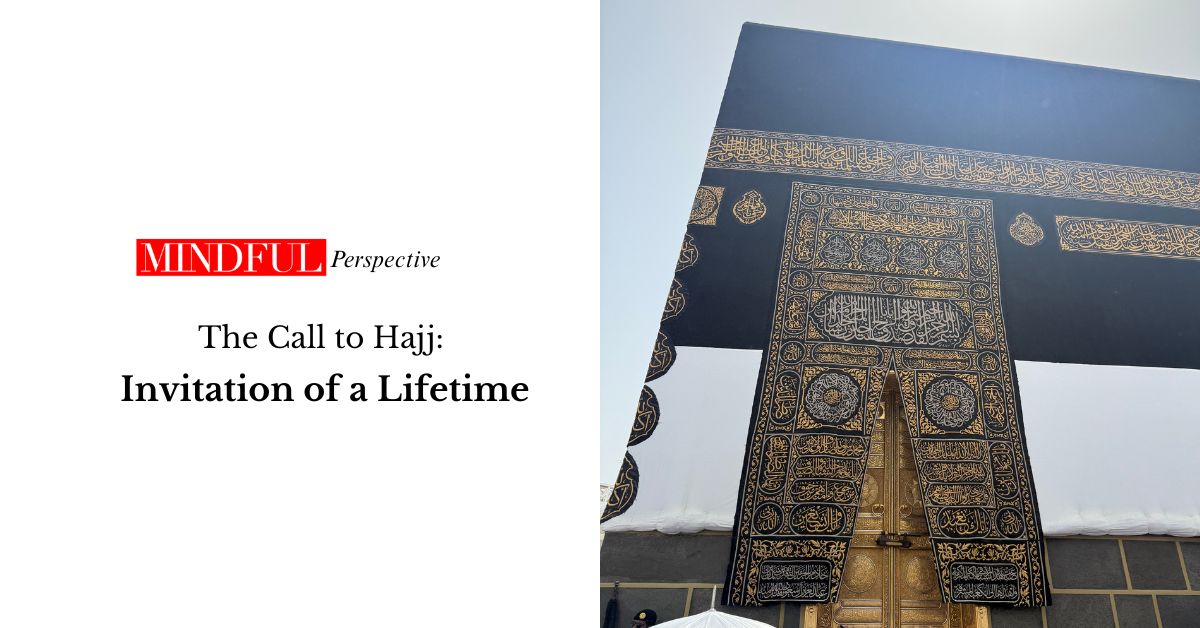
Every pilgrim comes to Hajj carrying a different story—a longing held for years, a prayer quietly answered, a moment of divine mercy, or a heart forever changed. The journey begins long before reaching Makkah, with a hope to be invited. Through these personal reflections from Hajj 2026, pilgrims share the moments of faith, struggle, gratitude, and transformation that continue to resonate long after returning home.
From Hira to the Heart
Misbah Momin
“Allahumma salli ‘ala Muhammad wa ‘ala aali Muhammad.”
With hearts overflowing with love and devotion, the pilgrims of the Zaka group who had longed to visit Ghar-e-Hira gathered in their designated buses, their voices rising in unison as they recited Durood-o-Salam upon our beloved Prophet Muhammad (SAW).
It was a deeply moving sight. Pilgrims of every age—young and old, the physically strong and those facing physical challenges—were united by a single purpose: to undertake the climb of nearly a thousand metres to reach the blessed Cave of Hira.
This was more than a physical ascent. It was a journey of the heart, inspired by profound love and reverence for Rasulullah (SAW).
As we climbed the mountain, the timeless words of Maulana Altaf Hussain Hali echoed in our hearts:
اُتر کر حِرا سے سوئے قوم آیا
اور اک نسخۂ کیمیا ساتھ لایا
Utar kar Hira se su-e-qaum aaya,
Aur ek nuskha-e-kīmiyā saath laaya.
These verses beautifully capture the moment when Rasulullah (SAW) descended from Ghar-e-Hira bearing the divine message of the Holy Qur’an—a message that would illuminate hearts and transform humanity forever.
Standing upon that sacred mountain, one could feel the immense significance of this blessed place—the very site where revelation first descended and from where the message of Islam began its journey across the world.
With every step of the climb, we were reminded of the sacrifices, patience, and unwavering perseverance of Rasulullah (SAW). It became clear that we were not carried upwards by physical strength alone, but by the love and devotion we held for our beloved Prophet (SAW).
As we finally reached the blessed cave, SubhanAllah, an awe-inspiring sight greeted us: a breathtaking panoramic view of Makkah stretching below.
Standing in that sacred place, every pilgrim seemed to carry the same heartfelt prayer:
“O Allah, wherever we prostrate, wherever our feet touch, wherever we walk, let those places be among the blessed places once touched by our beloved Prophet Muhammad (SAW).”
The moment was overwhelming. More than fourteen centuries ago, this very place witnessed the presence of Rasulullah (SAW), Hazrat Jibrael (AS), and Hazrat Khadijah (RA). To stand where they once stood filled our hearts with humility, gratitude, and a profound connection to our faith.
Many pilgrims were moved to tears—tears of gratitude, love, and reverence for the sacrifices of Rasulullah (SAW), through whom Allah gifted humanity the timeless message of Islam.
O Allah, grant us the honour of being in the companionship of Rasulullah (SAW) in the Hereafter. Grant us, our families, our generations, and the entire Ummah the tawfiq to understand, love, and follow the blessed Seerah and Sunnah of Rasulullah (SAW).
Aameen, Ya Rabb-ul-’Alameen.
In His Perfect Timing
Atiya Kidwai
For the longest time, I had been wishing and praying to go for Hajj. I had never even been for Umrah, and not being able to visit Makkah and Madinah had started to weigh heavily on my heart. We had travelled so much over the years, with our children and for ourselves, yet I couldn’t help but feel guilty that I hadn’t visited the Kaabah or Madinah, despite it being at the very top of my bucket list.
People often say that you only get to go when Allah invites you—when it is your time. This year, Alhamdulillah, it was ours.
I had heard countless people speak about falling in love with Madinah, but I never truly understood what they meant until I experienced it myself. Every word was true. The peace you feel there, the comfort, and the indescribable pull towards the city are unlike anything else. It is a love that doesn’t fade when you leave. In fact, it only grows stronger once you’re back home, leaving you longing to return again and again.
Hajj itself is a journey that transforms you. It makes you pause, reflect, and realise what truly matters. Somehow, despite swollen feet, exhaustion, the heat, or even an upset stomach, you keep going. You don’t feel defeated because you’re there for Allah—the One who created you and called you to His House. He gives you a strength you never knew you had.
If there is one thing this journey taught me, it is to keep asking Allah for what seems impossible. Ask Him to make every step easy, and trust that if He has invited you, He will make a way. Hajj is not something that can truly be explained. No words can fully capture its beauty or its impact. It is something that has to be lived.
May Allah invite everyone who longs to visit His House, accept our Hajj, and allow us to return again and again. Ameen.
When the Heart Returns
Hājrah Khan
ایس عشقے دی جھنگی، وِچ مور بولِیندا
سانوں قِبلہ تے کعبہ، سوہنا یار دسِیندا
Hajj—the very name and its enunciation—has a weight and volume attached to it. I had been wanting and waiting to go for Hajj since childhood. Having completed all four pillars to be checked off daily and yearly, the anticipation for this lifetime obligation was daunting, yet dreamlike in its fascination.
While I was to be away for about two weeks for Hajj, I left with the tacit expectation that I must write about my journey: what I thought, how I felt, and why it must be considered a somewhat spiritual sunrise of the self. It’s been about ten days since I got back, and it’s almost a phantom-limb sensation that the heart and mind can’t truly shrug off. It comes back in the most unexpected ways: the good and the bad, the ridiculous and the sublime, the pathos and bathos, the finite and the infinite. If Hajj is anything at all, among several things, it’s astoundingly epiphanous.
I finally understood that faith is deeply personal but powerfully proclamatory. Ritual is mechanical, but the meaning each symbol sacramentally holds is so intimate. Hajj is an isolating experience, yet so elevating. And I now can safely say that the Divine has an unspoken code that is unique to—and decrypted only by—its desired recipient. The Divine can speak through colours, metaphors, numbers, timing, food, faces, places, practices, pigeons, and even mountains.
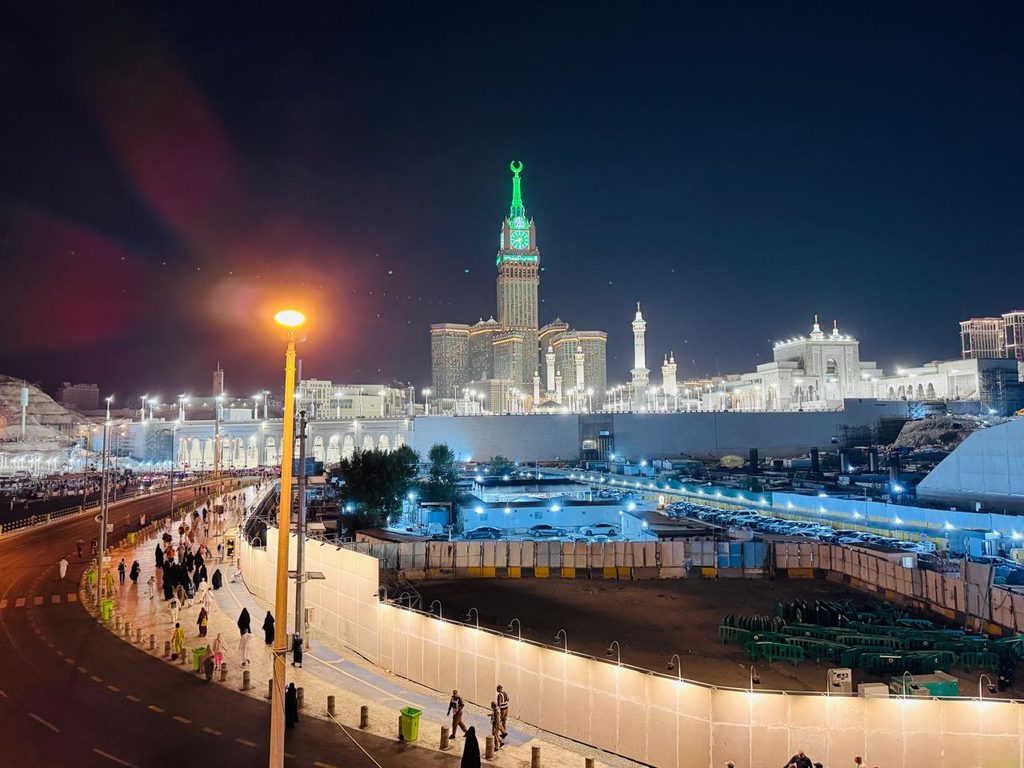
If Madinah, the Emerald City, is a cradle, Makkah, the Stone City, is a casket. Wasn’t Moses’s cradle also his casket? But it just so happened that it landed in the arms of the nemesis who somehow decided not to kill, but to care. And then He said, “He will be taken by an enemy of Mine and his. And I endowed you with My love so that you would be brought up under My watchful eye.”
And this is what it feels like: every step is being watched closely, carefully, with care. Almost every bus said, “We are the Guests of God,” and the hospitality was commendable, down to the deepest and most delicate of details. The casket kept becoming the cradle, and as a baby would cry relentlessly to be comforted, one would see tall, grown men, hands raised to the summer sky, just weeping mindlessly. One would see men, overweight and overborne, running as a woman once ran relentlessly between two barren hills, hoping for an oasis in a desert—and it sprung forth—while the women are to just waltz through now. One would see women and men, from riches reduced to rags, bound to sleep in sleeping bags under the summer night sky, just on the road, just like that, to feel the earth raw, real, hard, humbling. Yet the sleep was like a baby’s: uncaring surrender.
From Makkah to Minā, to Arafāt, to Muzdalifah, to the Jamarāt; then back to Makkah, then Minā and the Jamarāt, and then Makkah again. To see the Black Box that oversees us as we let the soul take flight, while the body merely roams around its corners, momentarily, planetarily, praying and feeling what the soul is so shy to share even with itself.
And for Hajj, like a baby in diapers, the Black Cloak is lifted to knee length, and the skin of the Kaabah is bare in its brick and base. So they say you kiss the Black Stone. I kissed the bricks of the Box’s bare skin. Always a rebel. Always a sentimentalist. And together, a fiery sacramentalist.
Three times we got to go round and round, and each time there was something dazedly new to feel and take away. The first visit was frazzled and frantic, the second was comfortable with comrades, the last circling was slow, solitary, sedimentary. But the final farewell, the fourth visit, was just stillness, almost stubborn in its naked sacredness—a bit too hard to let go. I think He did that on purpose: that we were to circumambulate outside the perimeters, only to enter through Gate 79 to behold the final glance and Last Gaze in perfect symmetry. It was, after all, the fourth visit, for four childhood friends who somehow came together from the four corners of the earth for the best journey of their lives.
This entry was an icebreaker to finally inch a little below and deeper than the iceberg’s tip. Hajj is, of course, the summit of worship. No wonder the new dusky-pink suitcases I specially bought for the journey were from a company called Summit. I wonder if the word is a purposefully playful pun on submit. And that’s the QED right there. You reach the summit to see how small the ground realities are, and all it took to get there—and now to come back—was to submit to what is Greater in its Grace and Grandeur. To be under the Watchful Eye, to look upon That Who Looks back.
The writer is a thinker, a literature teacher, and an Alimah.
She can be reached at hajrah.khan@gmail.com.
The Hajj of Youth
Aiza Hussain
In Pakistan, we usually hear of people going for Hajj in the later stages of their lives—once they’re done and dusted with their “responsibilities”: be it their bachon ki shadian (their children’s weddings), completing their homes, or fulfilling other obligations.
However, when I got married 2.5 years ago, my mother told me to emphasise “jawaani ka Hajj” (Hajj in your youth) in my duas. Before this, I had once made a preliminary plan with my siblings to go for Hajj, but it never materialised. I knew Hajj was important, and I possessed the desire to perform it, but little did I know that it was this important—and that Allah would invite me so soon. It was perhaps the biggest reminder that Allah had been listening so closely and carefully all this time.
It was one answered Tahajjud prayer that turned our lives around and opened our pathway to Hajj. I remember asking Allah extremely intently one Ramadan night, and then, one by one, everything fell into place: connecting with the right people, making our Hajj booking in time, gathering our finances, and naturally moulding our travel plans in the direction of Hajj.
For one reason or another, our visas and plans for all other destinations simply weren’t working out. Little did we know that those savings would eventually get us our tickets to Hajj. Everything magically aligned, step by step, for this beautiful calling. In my understanding, Allah was filling our lives with increased barakah by surrounding us with the optimum conditions for this higher calling.
When I performed Hajj this year, I did not expect it to be filled with so much ease. I had heard accounts of people having to demonstrate great patience and endure great hardship. In fact, one day, while talking to my dadi over the phone during Hajj, I told her, “I feel like I am waiting for when I will be tested. I know I will be, but when?”
And perhaps that is the beauty of doing Hajj in your jawaani: Allah fills you with amplified energy, conviction, and resilience. Never in my life had I felt so fresh with so little sleep over such a prolonged duration. On Day 3 in Mina, at Fajr, when one would usually expect their energy to be depleting, I found myself rejuvenated—to do more, to make the most of every second.
The energy of your youth, coupled with being in the most powerful of all spaces—the lands of our Prophets and the Sahabah—strengthens you in ways unparalleled. While there, it was as if no one and nothing else mattered. I was here as Allah’s guest, and I wanted to do everything within my ability to earn His pleasure.
Hajj is transformative in many ways, and in my opinion, it feels like Allah has given you an open invitation to ask for anything—and it truly is that beautiful. An accepted Hajj gives you the gift of earning a connection and proximity to God unlike any other journey.
Now imagine doing that when you’re still young and your “responsibilities” are still waiting for you. The Prophet (SAW) told us to hasten towards Hajj as soon as we have the means, so in the love of Allah and His beloved, I went—with the hope that He would bring me closer to Him.
Let’s just say the space here is limited, but His wonders are unlimited. Alhamdulillah.
If you are reading this and longing to go, I pray you find the strength to take the next step, and I pray that He answers your calling in the most beautiful way possible.
Signs of Divine Mercy
Sheikh Taimur Nawaz
Hajj is often described as a journey of faith, patience, and endurance. For my wife Maryam and me, it also became a journey filled with moments that felt like unmistakable signs of Allah’s help and mercy. Looking back, several experiences stand out—not because of what we achieved, but because of how events unfolded in ways we could never have planned ourselves.
Our journey began with significant delays. Our flight from Lahore was delayed by almost two and a half hours, and upon arriving in Madinah, we spent another two hours waiting on a bus due to logistical issues. These delays caused us to miss our group booking for Riyaz al-Jannah, and my individual booking was in jeopardy as well. By the time we reached the hotel, I had barely five minutes left before my entry slot expired.
Alhamdulillah, Maryam had activated her eSIM before arrival, allowing me to quickly download my Nusuk booking and even help others access theirs. We rushed towards Masjid al-Nabawi and made it just in time.
What happened next felt like Allah’s pure Fadl (divine bounty). While most pilgrims spend only a few minutes in Riyaz al-Jannah, I was able to remain there for nearly an hour and a half. I prayed Isha, offered Nafl prayers, and made countless duas in one of the most blessed places on earth. It was a gift I had neither expected nor planned for.
The Qur’an describes Fadl as a bounty granted by Allah out of His generosity, often beyond what we could anticipate, and that experience embodied exactly that.
Another moment came when we reached Makkah. I suffer from chronic migraines, and during the journey from Madinah, my headache intensified significantly. By the time I entered Masjid al-Haram, I was worried about how I would complete Tawaf.
Yet, as I began circling the Kaabah, the pain gradually subsided until I barely noticed it. Anyone who has lived with chronic migraines knows that they do not simply disappear. Yet during Tawaf, I experienced a level of relief that I still find difficult to explain.
Alhamdulillah, it felt like a mercy bestowed at precisely the moment I needed it most.
Perhaps the most physically demanding experience was our visit to Jabal al-Noor and Ghar-e-Hira. The decision was completely spontaneous. Maryam is flat-footed and not accustomed to strenuous hikes, while I was recovering from the flu and relying on medication to manage my symptoms. Our plan was modest: climb as far as we comfortably could and then return.
Instead, we completed the entire climb, spent nearly an hour at Ghar-e-Hira, prayed there, and returned safely in the early hours of the morning.
Throughout the climb, we kept wondering where the energy was coming from. The experience reinforced something many pilgrims discover during Hajj: when the intention is sincere, Allah often grants strength far beyond what we believe we possess.
These experiences reminded us that Hajj is not merely a physical journey. It is a journey that teaches trust in Allah’s wisdom, mercy, and power. Time and again, we witnessed that outcomes are not always determined by our plans.
What matters most is sincere intention and effort. The rest belongs to Allah, whose help often arrives in ways that exceed our expectations and imagination.
The Journey Within
Marium Jawaid Iqbal
As Muslims, performing Hajj becomes fard upon reaching adulthood when one possesses the financial means, and the physical and mental ability, to undertake the journey.
For years, the desire to perform Hajj lived within me like a glowing ember, quietly burning beneath the demands and distractions of life. Yet life had its own plans, and I found myself waiting until almost the age of 50 before I could finally make the decision to answer this sacred call.
When the intention was made and I began earnestly asking Allah (SWT) to fulfil this longing, everything changed.

His invitation arrived, and with it came preparations unlike any I had ever known.
Even before I left my home, my soul was in turmoil. Sleep became elusive. Long-buried memories surfaced without warning. Scenes from my childhood replayed before me. I remembered my parents, my siblings, my school days, my first marriage, and the births of my children.
Faces from the past returned as though no time had passed at all. Alongside them came the emotions I had once felt—the joy, the regret, the gratitude, the sorrow.
I found myself revisiting the story of my life.
I reflected on the good I had done and the mistakes I wished I could undo. I cried. I laughed. I repented. At times, my heart felt as though it might break under the weight of remembrance.
Yet beneath it all was a profound awareness of my need for Allah’s mercy and an overwhelming longing for hope.
When I arrived in Madinah, I knew I had entered a different space altogether. This was not merely a destination; it was a homecoming for the soul.
Standing in the city of our beloved Prophet Muhammad (PBUH), I sought guidance through his example and teachings. Sending blessings upon him, I prayed that every step I took would bring me closer to the path that leads to Allah.
I needed reassurance.
I needed clarity.
Above all, I needed acceptance.
Then came the journey to Makkah.
As we travelled towards the Holy City, one phrase escaped my lips again and again:
“I am coming to You, Allah.”
Those words carried the weight of a lifetime.
The tears flowed freely. I was not travelling towards a place; I was travelling towards my Creator. I longed to stand in His House, to feel His nearness, His protection, and His mercy. I wanted to arrive carrying all my weaknesses and leave carrying hope.
Hajj is unlike any other journey. It strips away the distractions and identities we cling to and compels us to confront ourselves with honesty.
It is an invitation to take stock of one’s life—to reflect, reassess, and renew.
It demands patience in discomfort, humility in crowds, generosity in hardship, and faith in moments of uncertainty. It teaches dependence upon Allah, tolerance of others, discipline of the self, and obedience to His command.
Amidst millions of people from every corner of the world, distinctions fade. Status fades. Wealth fades. What remains is the profound equality of human beings standing before their Lord.
And in that reality lies a powerful awakening.
The rituals are prescribed; some are obligatory, while others are recommended. Yet each carries a wisdom that unfolds through experience.
As one milestone follows another, physical exhaustion slowly gives way to spiritual fulfilment. The burdens carried for years begin to feel lighter. The heart softens. The soul expands.
A divine sense of hope takes root.
When others congratulate you upon completing Hajj, their words touch something deep within. You lower your head in humility, knowing that acceptance belongs to Allah alone.
Yet you cannot deny that something within you has changed.
You feel reborn.
And with that rebirth comes responsibility—the responsibility to honour the journey, to live more consciously, to love more generously, to worship more sincerely, and to strive every day to become a better version of yourself.
For after Hajj, you do not simply return home.
You return with a renewed heart.
The Aftermath
Madiha Saali A. Khan
It has been over a week since we all returned from the most sacred journey an ummati of Muhammad (SAW) can undertake: Hajj. The greater pilgrimage. That one leap of faith and submission that comes from out of nowhere and simply sweeps you away.
All the planning, the saving, the internal and external preparation—the questions of what to take, what to leave, the list of prayers and supplications to make each day, and a heart eager to please the Lord. A lifetime of anticipation, wrapped into a few days of exhilarating ibadat of the mind, body, and soul.
And then, just as it came, it disappears.
“Is it really over?” you ask yourself.
“But we just got here.”
Ah, you see, the truth of the matter is that everyone prepares you for the pilgrimage, but no one ever mentions the aftermath. The heavy, deeply unsettling aftermath of returning as a new version of yourself to the same world you left behind only two weeks ago.

Of course, you are happy to be back amongst family and friends, celebrating your return, grateful and cleansed. But how on earth are you supposed to settle back in? How do you return to the same worldly chaos and the pursuit of wealth and power that you stepped away from just days ago?
How do you explain to those around you that parts of you are still lingering in the jamal of Madinah, wandering its streets and drawn towards the blessed presence of the Green Dome?
How do you explain that a little piece of you remains behind in sajdah on the green carpets of Riyaz al-Jannah?
That a part of you stayed behind at Uhud, where you stood in the presence of the memory of Ameer Hamzah.
How do you describe the nights in Mina, like a gathering of souls under the open sky, surrounded by strangers who somehow became companions of the heart?
How do you put into words the afternoon of Arafat, where strong men wept like children beneath the scorching sun, raising their hands and begging Allah to erase their past and lift the weight of sins they had carried for years?
How do you describe that night in Muzdalifah, when you were stripped of worldly comforts, placed upon the earth among millions of equally vulnerable pilgrims, simply existing through the night in surrender and hope?
The satisfaction of gathering those same pebbles and casting them at the Jamarat, knowing you are completing an act of worship beloved to Allah.
And that first glimpse of Allah’s magnificent House—the takbeerat, the marble beneath your blistered feet, the golden door shining as you approach the green light, turning towards it and reciting:
Bismillahi Allahu Akbar wa lillahil hamd.
How do you narrate your final goodbye?
That last glance.
The one you keep stealing between pillars and partitions until you finally leave the Haram.
No one prepares you for this.
No one tells you that you will never be exactly the same again.
Before you went, you wondered why people return again and again. You thought: Isn’t it better to send someone else?
But that is the thing—only someone who has tasted it understands why they long to return. There is no greater surrender, no greater sweetness, than this.
Every cell of your being dances in joyful submission. You have tasted it now. There is no going back from this.
And Alhamdulillah for that.
If this is your state today, on this ordinary Tuesday of June—Mubarak.
You went to Allah’s House and returned transformed. Your qalb is now in a constant state of Tawaf.
Close your eyes, and you can return to any moment of elevation you experienced during Hajj. Your soul now carries the ability to anchor itself in those sacred memories.
Mubarak.
You did not simply travel all the way to meet Allah.
You also met your true self.
A Sufi saint once said:
“Do not ask whether your dua was accepted after Hajj. Ask whether Allah allowed your heart to remain turned towards Him after Hajj.”
The real Hajj begins now.
The qalb is purified.
The soul is connected.
The darkness has been removed.
Hazri ho gayi.
Ab dil huzoori mangta hai.
To remain in the presence of Allah.
To remain in the love of RasoolAllah (SAW).
Welcome to the true essence of Labbaik.
Welcome.
This is the aftermath.
A Beautiful Relationship
Salim Khan
Hajj is, above all, a deeply personal journey centred on one’s relationship with Allah (SWT) and His Beloved Prophet Muhammad (SAW). While every pilgrim’s experience is unique, the true essence of Hajj lies in strengthening this spiritual connection. Those who approach the pilgrimage with the intention of drawing closer to Allah (SWT) and following the example of the Prophet (SAW) often find the experience profoundly transformative.
Before embarking on this sacred journey, it is important to reflect on the state of this relationship. Hajj requires considerable time, effort, and financial commitment, making it essential to prepare not only physically but spiritually. Cultivating a genuine longing for Allah (SWT) and His Messenger (SAW) enriches every act of worship performed during the pilgrimage, allowing each ritual to be experienced with greater meaning and devotion.
This relationship, however, is deeply personal. Every individual connects with their Creator in their own way, and that connection continues to grow through sincere intention and effort. As the Prophet (SAW) said:
“Allah Almighty says: Whoever draws close to Me by the length of a hand, I will draw close to him by the length of an arm.”
It is this divine mercy and invitation that makes Hajj such a remarkable opportunity for spiritual renewal.
Equally important is understanding the significance of Hajj before undertaking it. Learning about the pilgrimage, its origins, and the sacrifices and hardships endured by the Sahaba (RA) allows one to appreciate the deeper meaning behind each ritual. Knowledge transforms actions into conscious acts of worship, deepening one’s connection to faith.

Ultimately, Hajj is an act of complete submission. Every ritual is performed because it was commanded by Allah (SWT) and exemplified by the Prophet (SAW). Even practices such as shaving the head are carried out in loving obedience, following the Sunnah and the prayers the Prophet (SAW) made for those who fulfilled this act.
These outward actions become powerful expressions of faith, humility, and love.
For every Muslim who possesses the means, Hajj is an aspiration that should not be unnecessarily delayed. More than a journey to a sacred place, it is a journey that has the power to transform the heart, strengthen one’s relationship with the Creator, and deepen one’s love for His Beloved Messenger (SAW).

